
The Republic of the Congo: Building a Whole-of-Government NDC 3.0
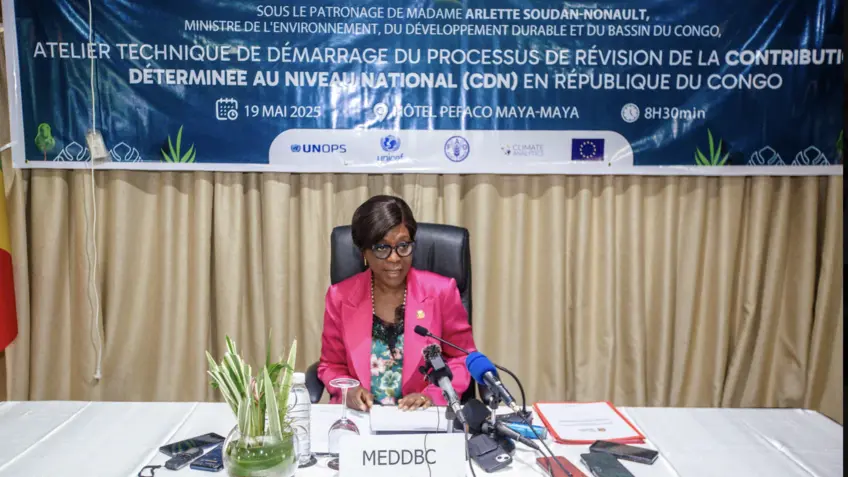
In February 2026, the Republic of the Congo submitted its third-generation Nationally Determined Contribution (NDC 3.0), marking a shift toward a more country-owned, whole-of-government approach.
With coordinated support through the NDC Partnership, the government developed a more realistic, data-informed NDC aligned with national development priorities, establishing a stronger, more actionable foundation for implementation and investment.
Coordinating a Country-Led Process
In 2024, the Ministry of Environment, Sustainable Development and the Congo Basin (MEDDBC) requested support through the NDC Partnership to strengthen the NDC development process. This included embedded in-country facilitation and targeted partner support to ensure the process was both government-led and technically robust.
Through this embedded in-country facilitation, the NDC Partnership mobilized and coordinated financial support, ensuring partner contributions aligned with government priorities and were delivered through a structured, country-led process.
“The work mainly consisted of aligning and coordinating the technical and financial partners involved in this process,” says Darol Nkanza, NDC Partnership In-Country Facilitator. “This coordinated approach greatly strengthened the foundation for implementation.”
The facilitator ensured that partner support mobilized through the NDC Partnership was well coordinated and grounded in national needs. Working with implementing partners, the Central African Forest Initiative (CAFI) — a partnership between donor countries — provided technical support for data collection, analysis and drafting. The European Union (EU) supported the Republic of the Congo in strengthening its climate governance frameworks, the Food and Agriculture Organization (FAO) helped strengthen land use, land-use change and forestry (LULUCF) sectors and greenhouse gas (GHG) inventories, and the United Nations Children's Fund (UNICEF) supported the integration of gender, youth and social inclusion.
Grounding Targets in Sector Plans and Realities
“The minister provided a very critical diagnosis of the previous NDC, which had many data anomalies,” says Junior Nianga Okanda, NDC Partnership Focal Point. “This led us to adopt a more pragmatic approach, working directly with sectors to define targets based on available data and what could realistically be delivered.”
MEDDBC worked directly with line ministries to build targets from sector plans, data and annual reporting processes so that targets reflected what sectors are already planning, tracking and realistically able to deliver.
“In the waste sector, for example, projections were previously based on speculation rather than quantitative data,” says Mr. Okanda. “We adopted a more pragmatic approach this time. We avoided commitments that the country would not be able to meet and focused instead on realistic targets.”
This process also strengthened ownership across government. By clearly linking climate action to sector priorities — such as energy diversification and cost reduction — the NDC was repositioned as an opportunity for development rather than an external requirement.
“When things are well explained, people participate,” says Mr. Okanda. “Many initial resistances — especially in agriculture and energy — were overcome by showing that the NDC creates opportunities.”
For the first time, a broader range of stakeholders, including the energy and private sectors, contributed to defining climate priorities, resulting in more credible and actionable targets.
“Our NDC is more relevant and more robust because the actions came directly from the sectors, not just from consultants,” says Mr. Nkanza.
Linking Climate Priorities to Development Planning and Finance
To strengthen country ownership, the NDC 3.0 is explicitly aligned with the Republic of the Congo's 2022–2026 National Development Plan and is designed to inform future development planning cycles. This alignment helps ensure that climate priorities are embedded within national decision‑making, investment planning and budget processes rather than treated as a standalone agenda.
The NDC Partnership Support Unit and in-country facilitator helped align technical inputs and partner support with national planning and governance processes, strengthening the link between climate targets, institutional frameworks and financing strategies.
To support implementation, the country established the National Environment Agency, which will host a dedicated climate office responsible for coordinating monitoring, reporting and verification (MRV) across government. This institutional setup provides a foundation for tracking progress and engaging finance and sector ministries over time, helping integrate climate considerations into planning and investment decisions.
Total investment needs for the Republic of the Congo’s NDC 3.0 are estimated at USD 8.6 billion for 2025–2035, with 20% expected from domestic resources and 80% conditional on international support. To access finance, the country is integrating climate priorities into public finance frameworks and taking steps to expand access to international climate finance. The NDC includes references to Article 6 market mechanisms and the Loss and Damage Fund as part of a broader strategy to diversify funding sources.
Moving Ahead with Implementation
“With the NDC 3.0 submitted, implementation is the next step,” emphasizes Mr. Okanda. “Beyond drafting and submission, the focus must now be on delivering results through the NDC.”
The MEDDBC is developing an NDC action and investment plan, with technical support from CAFI and Climate Analytics mobilized through the NDC Partnership, to prioritize projects and strengthen their bankability to attract public and private finance.
The government has also requested additional support from the NDC Partnership to establish a national climate fund and embed climate finance expertise to better coordinate financial flows and reduce fragmentation.
“The main lesson from our NDC 3.0 process is the importance of strong government leadership,” says Mr. Nkanza. “The ministry coordinated the process, defined priorities and guided implementation. This needs to continue.”
The Republic of the Congo’s experience demonstrates how coordinated support through the NDC Partnership can strengthen country ownership, align climate targets with national development priorities and link planning to finance — strengthening opportunities for implementation.
Read the Republic of the Congo's NDC 3.0 and visit the Republic of the Congo's country page for the NDC Partnership.