
From Budget Codes to Gender-Responsive Forest Management: Climate Action in Zambia
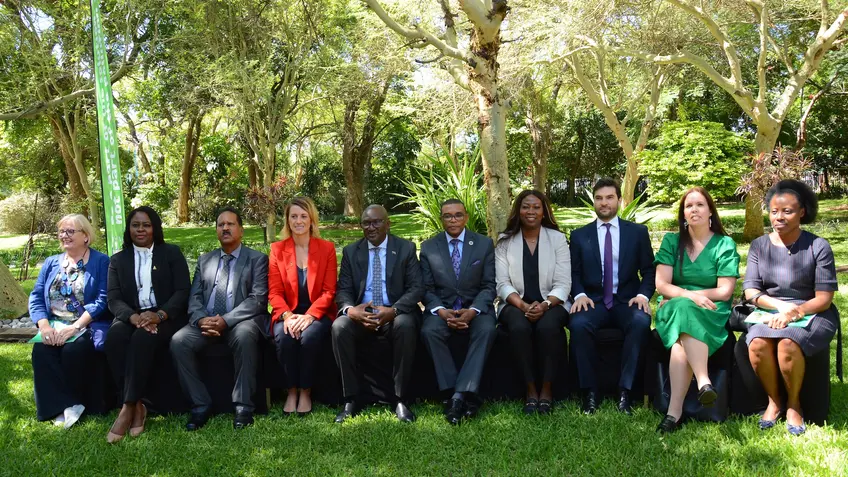
With southern Africa’s surface temperature warming faster than the global average, Zambia is already feeling the impacts of climate change. Rising temperatures, recurring droughts and unpredictable rainfall are disrupting agriculture, water security and rural livelihoods. These pressures are undermining food production, rural incomes and economic growth — making climate action a national development priority.
With NDC Partnership support, the government is reforming policy and public finance and tracking climate action in real time while delivering adaptation projects that protect communities from floods and droughts — turning NDC ambition into real, local impact.
The following highlights illustrate how Zambia is advancing climate action with support from the NDC Partnership:
Integrated Climate and Development Policy and Legislation
Zambia has laid a strong legislative and policy foundation for climate action that links climate with national development. The Green Economy and Climate Change Act of 2024 established a council of ministers chaired by the vice president to guide climate policy, a national Climate Change Fund and rules for regulating carbon markets. Together with the 2025–2030 Green Growth Strategy and the Eighth National Development Plan (8NDP), these frameworks integrate climate priorities into the country’s broader development agenda and ensure climate investment decisions have high-level political backing.
Finance Reforms
Zambia has complemented its policy and legislative environment with reforms in public finance and financial regulations. The Bank of Zambia, with support from the United Nations Development Programme (UNDP) through Partnership Action Fund (PAF) funding, has issued green finance guidelines and a green loan supervisory manual to help commercial banks assess climate-related risks and structure green lending. The Ministry of Finance and National Planning, with assistance from the Common Market for Eastern and Southern Africa (COMESA) through PAF, is developing climate budget codes. These will track how public resources flow to NDC priorities and identify funding gaps. These reforms give the government and its partners the information and incentives needed to improve both public and private investment in climate action.
Tracking NDC Progress
To track climate finance flows and NDC progress, the government launched an online NDC implementation framework in 2023, developed with support from the NDC Partnership through PAF. Hosted in the NDC Implementation Plan Online Tool, the framework sets priorities across 11 sectors. By late 2024, it had logged more than USD 7 billion in committed climate finance, including USD 1.2 billion from domestic sources. Updated in real time by government focal points and the NDC Partnership’s in-country facilitator, the framework captures technical support needs, funding and financing gaps and new NDC-aligned projects as they emerge.
“What began as a tracking system has become a strategic platform for ministries, funders and private investors to see what still needs support and where new investments can have the greatest impact,” says David Kaluba, the NDC Partnership in-country facilitator for Zambia.
Community Adaptation
Zambia’s policy and finance reforms are translating into tangible climate resilience projects across communities.
In drought-affected areas, the Netherlands, through the NDC Partnership, is financing a gender-responsive integrated water resources management project that rehabilitates small-scale dams and strengthens community-based dam management. Implemented by the Ministry of Water Development and Sanitation, the initiative promotes nature-based solutions for catchment protection, trains local water user associations and integrates gender equality in water governance, recognizing that women bear the brunt of water scarcity. The project will reach more than 10,000 households, half of them women-headed, across drought-prone districts such as Monze and Pemba, providing secure water for domestic use, livestock and small-scale farming.
At the same time, through Canada’s Climate Action Africa (CAA) initiative, Zambia is receiving technical assistance to strengthen gender equity and inclusion in community forest management groups (CFMGs). The support focuses on developing standardized methodologies, training modules and best practices for mainstreaming gender in community forestry, while strengthening governance and institutional frameworks that ensure equitable participation and benefit sharing. The initiative includes training of trainers to equip stakeholders with the tools and knowledge to monitor inclusiveness, address land and tenure inequalities, and apply social and environmental safeguards in forest and carbon-related projects. These efforts are helping expand women’s leadership in forest governance and strengthen the role of community forestry in climate mitigation and adaptation.
The government also secured EUR 17 million through the International Climate Initiative (IKI) FACE-NDC program after the NDC Partnership’s in-country facilitator and embedded climate finance advisor helped prepare the expression of interest. The program will channel resources to priority mitigation and adaptation actions identified in Zambia’s NDC implementation framework.
The projects are captured in the implementation framework, providing clear evidence of Zambia’s NDC progress and helping refine its project pipeline.
“The NDC 3.0 investment plan, informed by our implementation tracking, will help us match priorities with partners and channel finance where it has the greatest impact for national programs to local adaptation projects,” says Mr. Kaluba.
Prioritizing Investment in Zambia’s NDC 3.0
In early 2025, Zambia completed a comprehensive NDC stocktake, with support from UNDP, the Food and Agriculture Organization (FAO) and the United Nations Children’s Fund (UNICEF) through the NDC Partnership. The findings shaped Zambia's NDC 3.0, which was developed with UNDP and World Bank support through the NDC Partnership.
At the same time, the World Bank and the United Nations Environment Programme (UNEP), also through the NDC Partnership, are supporting preparation of the NDC 3.0 investment plan, an updated implementation framework and capacity building initiatives to ensure that climate ambitions remain fully aligned with Zambia’s long-term development strategy.
The new NDC will maintain a strong focus on adaptation and resilience, building on the progress made under the 2021 NDC and continuing to align with the UAE Framework for Global Climate Resilience. The country’s targets and sectoral priorities have been finalized as part of the NDC 3.0 process, guided by extensive stakeholder consultations across government, civil society and the private sector. Zambia has expanded from six to ten sectors for mitigation and adaptation, including energy, transport, liquid waste, tourism, coal, industrial processes and product use, infrastructure, health, agriculture and forests.
Training and technical assistance mobilized through the NDC Partnership is also helping ministries prepare feasibility studies, refine concept notes and strengthen access to international funds such as the Green Climate Fund (GCF). Work is underway to design blended-finance mechanisms and to operationalize the carbon market framework established under the Green Economy and Climate Change Act of 2024, further expanding options for private investment.
Toward a Resilient, Vibrant Future for Zambians
Zambia is demonstrating how national leadership, coupled with coordinated partner support, can drive NDC implementation that delivers greater community resilience.
“Through NDC Partnership support, we have been able to act on national priorities in real time and aligned our NDC and development agenda with the aspirations of our people,” says Ephraim Shitima, NDC Partnership focal point and Director of Green Growth and Climate Change at Zambia’s Ministry of Green Economy and Environment.
With NDC 3.0 taking shape, strong policy and legislative frameworks, transparent tracking and a growing pipeline of bankable projects position Zambia to mobilize the finance needed for resilient, thriving communities and economic growth and development.