
From Planning to Finance: Lessons from East Africa and Small Island Developing States

In early 2026, two convenings — one in East Africa and one for Small Island Developing States (SIDS) — brought together practitioners facing a shared challenge: how to mobilize finance to implement Nationally Determined Contributions (NDCs).
The 7th East Africa Climate Finance Directors’ Level Meeting (EACFDLM) in Rwanda convened 30 senior officials representing six countries in the East African region, as well as development partners.
Shortly after, the first Regional Forum for Practitioners in SIDS, held in Mauritius, brought together 120 participants from 14 countries — including government, civil society, implementing organizations and business associations — alongside technical experts and private sector stakeholders.
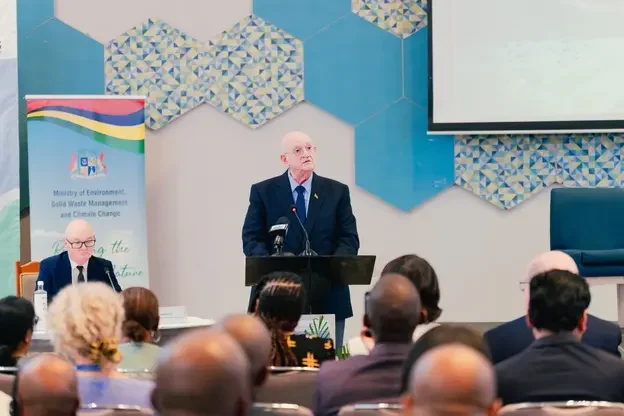
The Honorable Rajesh Anand Bhagwan, Minister of Environment, Solid Waste Management and Climate Change at the Regional Forum for Practitioners in SIDS on Advancing NDC Implementation Readiness / Photo by Mantra Connexions
While country contexts differ, and the unique circumstances of Least Developed Countries (LDCs) and SIDS shape their priorities, bringing practitioners together helps countries co-create solutions. In Mauritius, discussions emphasized SIDS-specific constraints, including limited fiscal space and high climate vulnerability, which guided proposed solutions. In Rwanda, EACFDLM participants further aligned national and regional priorities while reflecting on COP30 outcomes and strengthening regional cooperation and learning.
Across both convenings, participants highlighted the obstacles countries face, the solutions being deployed and the implications for improving access to climate finance.
Barriers to Accessing Climate Finance
Despite differences in geography and national contexts, participants across both convenings identified overlapping challenges:
Fragmented, project-by-project financing makes it difficult to achieve scale and sustain long-term climate action.
As highlighted in a recent Policy Brief from the Center for Access to Climate Finance, adaptation finance continues to fall short of countries’ needs, particularly in SIDS and LDCs. This gap is exacerbated by fragmented, project-based funding, misalignment between funder and country priorities, and limited coordination between government ministries, partners and financiers.
Coordination gaps, particularly between finance and environment ministries, limit the integration of climate priorities into budgets and fiscal policy and hinder access to finance.
At both events, participants emphasized that where dedicated climate finance units (CFUs) are absent or there is no ministry with a clear mandate to coordinate actors and manage finance flows across sectors, countries face difficulties in placing climate at the center of public finance.
Building investment-ready project pipelines is a common challenge.
At the SIDS forum, participants emphasized the need for dedicated technical support to develop projects that meet investor requirements. Identifying projects is only the first step. Significant time, specialized capacities and resources are needed to transform them into structured, investable pipelines. Similarly, EACFDLM speakers noted that while pilot initiatives often show results, scaling them, integrating them into national systems and preparing them for private sector investment remains difficult.
Private sector engagement remains inconsistent, limiting the pace and scale of finance mobilization.
With available official development assistance (ODA) declining, mobilizing finance from the private sector has become more urgent and challenging. Private finance remains difficult to mobilize in LDCs and SIDS, where high perceived risk, limited bankable pipelines, weak institutional and regulatory environments, and insufficient incentives make it difficult for private actors to engage at scale.
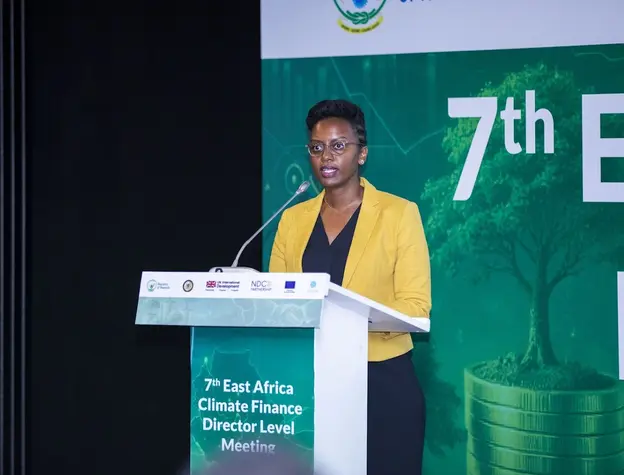
Hon. Mutesi Rusagara, Minister of State for Resource Mobilization and Public Investment, Rwanda, at the 7th East Africa Climate Finance Directors’ Level Meeting / Photo by GGGI Uganda, GGGI Rwanda and Ministry of Finance and Economic Planning (MINECOFIN), Rwanda
Country Approaches in Practice
Across both convenings, countries described their process of shifting from projects to programmatic approaches, building institutional coordination mechanisms and exploring market-based tools to mobilize finance.
Countries are demonstrating how programmatic approaches can translate climate ambition into coordinated, scalable action.
The Rwanda Green Fund illustrates how programmatic approaches and long-term programming, built through shared understanding with partners and private sector engagement, can deliver results across sectors. In Mauritius, SIDS practitioners emphasized that long-term planning reduces perceived risk and helps attract private investment, strengthening socioeconomic resilience. A country-led, programmatic approach with multi-year financing, linked to national budget cycles, can secure long-term financing at scale while reducing administrative burdens.
Countries are emphasizing evidence-based prioritization and structuring priorities into pipelines that can attract and absorb finance.
Countries increasingly recognize that data‑driven project prioritization strengthens the credibility of their investment plans, builds investor confidence, and improves their ability to attract financing. In East Africa and SIDS, practitioners highlighted the need for more targeted technical assistance and project preparation facilities (PPFs) for the design to address early-stage gaps and prove project viability.
Local stakeholder engagement is helping countries develop investment-ready initiatives that reach communities.
The Least Developed Countries Initiative for Effective Adaptation and Resilience (LIFE-AR), Local Climate Adaptive Living Facility (LoCAL) and Kenya’s Financing Locally Led Climate Action (FLLoCA) offer models for channeling finance to the local level, as highlighted in the programmatic approaches Policy Brief.
CFUs are gaining traction as an institutional response to coordination and pipeline challenges.
Nearly all East African countries at EACFDLM and several SIDS Forum participants have or are establishing CFUs, with Uganda, Rwanda, Fiji and Mauritius having done so. Their effectiveness relies on a strong mandate, clear roles and responsibilities, proper staffing, high-level political backing and the authority to convene ministries and key stakeholders. Institutional memory is equally important. Systems to codify data and standardize procedures help CFUs retain expertise and sustain relationships. Where these conditions are met, countries are increasing the efficiency in mobilizing and managing climate finance, including the integration of climate into national financial planning and macroeconomic modeling.
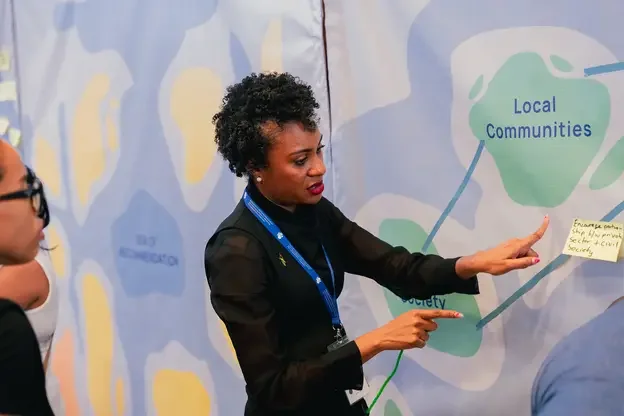
Regional Forum for Practitioners in SIDS on Advancing NDC Implementation Readiness — February 2026, Mauritius / Photo by Mantra Connexions
Mobilizing private finance requires governments to make a compelling economic case for climate action and create structured entry points for private capital.
Public finance plays a catalytic role through concessional funding and risk mitigation that creates the conditions for private investment. However, unlocking that investment also requires climate resilience to be framed as an economic opportunity, not a cost. Countries are working to make that case through regular private sector dialogue, targeted incentives and blended finance models anchored in strong policy frameworks and bankable project pipelines.
Countries are deploying a range of market-based instruments to attract climate finance.
Green taxonomies, bonds and debt swaps are all gaining traction as tools to attract climate finance, but their effectiveness depends on their integration into broader systems. Kenya has aligned its green taxonomy with NDC priority sectors, while Rwanda takes a dual-metric approach, targeting sectors with both high emissions and significant contributions to GDP. In SIDS, green and blue bonds show promise, working best when paired with strong project pipelines, aligned with international standards and structured to reflect social dimensions that broaden investor appeal. Debt swaps can create fiscal space, as Seychelles and Cabo Verde have demonstrated, but are strongest when anchored in long-term fiscal policy and integrated into macro-fiscal planning.
Collaboration Across Countries
Both convenings surfaced that many of the challenges countries face individually are more tractable when addressed collectively. Beyond peer learning, these fora function as informal knowledge networks and mutual accountability mechanisms. Countries learn from the challenges that peers have already worked through while cultivating regional solutions and partnerships that last beyond the events.
At the SIDS forum, participants identified opportunities for regional cooperation, including a unified SIDS Blue Economy Finance Framework and a regional listing and trading platform for sustainable financial instruments, inspired by the Blu-X platform from Cabo Verde. A proposed Regional Technical Support Pool would provide on-demand expertise for project design, bankability assessment and investor engagement.
In East Africa, biannual EACFDLM meetings are held since 2023 to advance country-driven, programmatic approaches to accessing climate finance aligned with national development priorities. Discussions are advancing with the African Development Bank and the East African Community to anchor the forum regionally and develop collaborative project pipelines. With Uganda as Co-Chair of the Taskforce on Access to Climate Finance and the Coalition of Finance Ministers for Climate Action, there is a strong momentum and opportunity to align these initiatives.
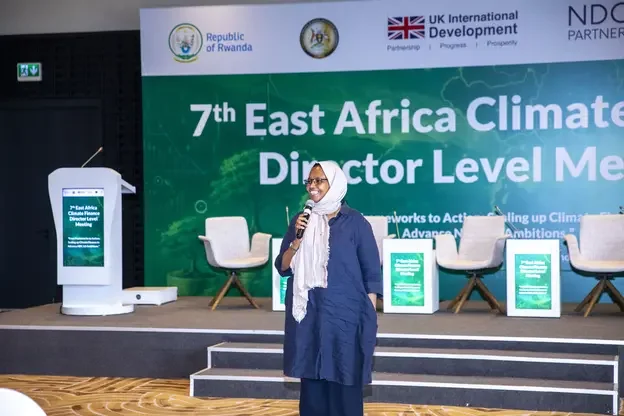
Ayan Harare, Climate Finance Coordinator, Ministry of Environment and Climate Change, Somalia, at the 7th East Africa Climate Finance Directors’ Level Meeting / Photo by GGGI Uganda, GGGI Rwanda and Ministry of Finance and Economic Planning (MINECOFIN), Rwanda
The Role of the Center for Access to Climate Finance
The Center for Access to Climate Finance (Center), hosted by the NDC Partnership Support Unit, contributed directly to the organization of both convenings.
The Center draws on evidence from across the NDC Partnership and the Taskforce on Access to Climate Finance, identifying what is replicable and making it available to countries and partners supporting them.
To learn more, visit the Center webpage to access its Policy Briefs on CFUs and country-led programmatic approaches, which provided an evidence base for discussions in both Rwanda and Mauritius.
Acknowledgements
The 7th EACFDLM was organized by the Government of Rwanda in partnership with the Government of Uganda through the Ministry of Finance and Economic Development. The event was funded by the UK’s Foreign, Commonwealth & Development Office (FCDO), with technical support provided by the Global Green Growth Institute (GGGI). The NDC Partnership Support Unit, in its capacity as host of the Center for Access to Climate Finance, contributed to event planning.
The SIDS forum was co-organized by the Deutsche Gesellschaft für Internationale Zusammenarbeit (GIZ), the NDC Partnership Support Unit and the Center for Access to Climate Finance as well as the Commonwealth Secretariat through its Commonwealth Climate Finance Access Hub. This exchange was also supported by the UNFCCC Regional Collaboration Centres (RCCs), the World Bank, the United Nations Development Programme (UNDP), the United Nations Environment Programme (UNEP), Climate Analytics and other partners.
