How Small Island Developing States are Building an Action-Oriented Climate Agenda
Small Island Developing States (SIDS) are increasingly focused on turning their Nationally Determined Contributions (NDCs) into measurable outcomes in the face of growing climate risks. But progress depends on connecting readiness and finance, pairing strong institutions and planning with the investment needed to translate commitments into action.
While each country faces distinct circumstances, many are grappling with similar challenges, from capacity to financing constraints that limit the pace and scale of implementation. Bringing SIDS together creates an opportunity to evaluate what works and identify pathways for accelerating action in resource-constrained contexts.
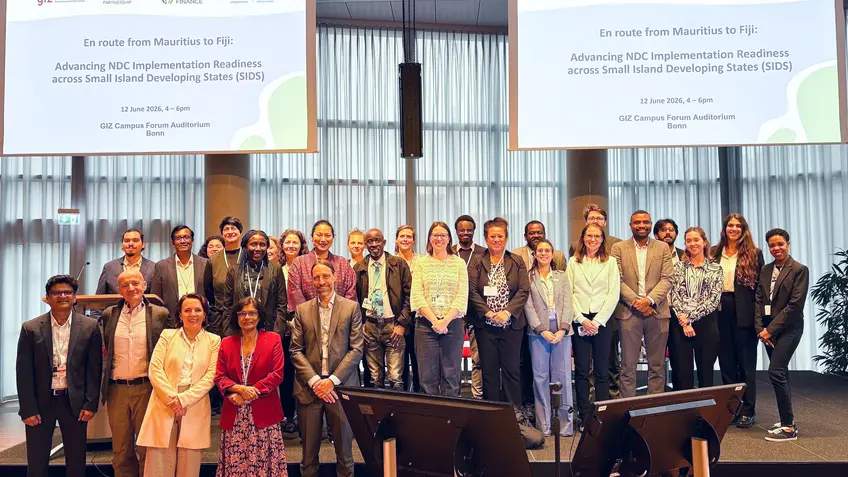
During a series of peer-to-peer gatherings among SIDS in Mauritius this past February and again at the June Climate Meetings in Bonn, participants explored this central question: What actions can SIDS take to strengthen implementation readiness and accelerate climate action?
Building on the high-level recommendations for advancing NDC implementation readiness in Mauritius, participants in Bonn continued to develop and refine a shared "action agenda" amid growing pressure on the multilateral system. As geopolitical tensions and constraints on climate finance intensify, enhanced cooperation is becoming increasingly important for SIDS aiming to quicky advance their climate goals.
The emerging priorities outlined below highlight how local knowledge, regional collaboration and global support can help countries move from planning to delivery. Together, they demonstrate the value of peer exchange in advancing solutions and offer lessons for partners seeking to support SIDS-led climate action.
Advance Participatory Frameworks
Climate action is more effective and sustainable when national systems are connected to the communities already adapting to climate impacts through participatory frameworks. Across SIDS, local and Indigenous knowledge offer direct insights into resilience, disaster preparedness and changing environmental conditions. However, this information is not always reflected in formal planning and implementation processes, leaving grassroots knowledge from fishers, farmers and community networks — currently sitting outside official systems — untapped.
Structured feedback mechanisms are crucial to connecting community experience with government decision-making, academic research and national planning processes. This includes localized capacity building systems that respond to subnational needs. For instance, Madagascar holds monthly NDC Partnership Implementation Committee meetings to support implementation across sectors and stakeholders from the local to national levels.
Integrating a broader range of knowledge into national systems can help countries progress from simple planning toward climate responses that are practical, trusted and effective.
Establish Regional Solutions for Collaboration and Joint Action
SIDS confront a distinct combination of limited institutional capacity, geographic isolation and high climate vulnerability that shapes their climate planning and priorities. These shared challenges make regional collaboration among SIDS instrumental in achieving national progress.
Regional cooperation enables SIDS to pool and build expertise based on a systematic assessment of available capacity, creating more durable systems for implementation. Shared data systems and knowledge platforms and technical matchmaking platforms improve the efficiency and consistency of data collection to inform decision-making.
Capacity building must also extend beyond short-term technical assistance — with green jobs and skills positioned as a key priority for developing the workforce required to implement NDCs. By integrating climate-related competencies — including greenhouse gas inventories and Biennial Transparency Reports (BTRs) — into academic curricula, countries can build lasting national capacity where it is currently lacking.
Strengthen Climate Finance Access and Technical Capacity for Adaptation and Resilience
For SIDS, climate finance access is not only a question of volume but of whether finance systems are designed to match country realities and implementation needs. The 39 SIDS nations received just over USD 2 billion per year in international public climate finance for adaptation from 2021–2022 despite requiring approximately USD 12 billion annually. At the same time, many countries continue to face barriers in accessing and deploying resources that are available.
SIDS require simpler and more coherent climate finance processes, stronger coordination between countries and finance providers and financing approaches that better reflect SIDS-specific constraints. Strengthened institutional arrangements, including dedicated climate finance units (CFUs) and other coordination mechanisms, are important tools for translating national priorities into investment-ready pipelines.
To mobilize resources, countries need sustained international support to build technical capacity to design projects and implement adaptation measures. For instance, water availability and water resource management are critical priorities for low-lying and atoll island states where freshwater security is closely linked to long-term resilience. Strengthening ecosystem-based adaptation, nature-based solutions and ridge-to-reef approaches can support livelihoods, protect biodiversity and boost the economic sectors that many SIDS depend on.
Informing the Road to Fiji and COP31
The conversations at Bonn point to a growing focus on building implementation readiness paired with a concerted effort to mobilize capital. SIDS have identified the integration of local knowledge into planning processes, programmatic approaches that enhance coordination within ministries and financiers, regional cooperation and sustained international support as essential to delivering their commitments.
Dialogue in Bonn, following a similar engagement in Mauritius, is enabling SIDS to build a coherent, SIDS-focused agenda for accelerating action. These exchanges create space for countries to connect with partners, explore next steps on their latest NDCs and learn from innovative approaches that are already delivering results in comparable contexts — rather than simply focusing on shared challenges.
To learn more about SIDS’ shared action agenda for accelerating implementation readiness, read the full technical brief.
Watch: Practitioners reflect on the challenges and opportunities shaping NDC implementation across SIDS
To learn more, contact the NDC Partnership Support Unit at [email protected].
Upcoming Webinar Series: From Nadi to Antalya | Spotlight on SIDS
The UNEP Copenhagen Climate Centre, the Deutsche Gesellschaft für Internationale Zusammenarbeit (GIZ), NDC Partnership Support Unit and the Center for Access to Climate Finance invite policymakers, SIDS practitioners, development partners and climate experts to a joint three-part virtual event series.
Grounded in the recommendations of the Technical Brief and the outcomes of the Mauritius Regional Forum, this series maps out practical pathways to strengthen local capacity and interregional collaboration, streamline climate finance and scale resilience in the lead-up to COP31:
- Session 1: Building Water Resilience for Climate Adaptation and NDC Implementation
- Session 2: Improving Access to Climate Finance
- Session 3: Regional Solutions for Collaboration and Joint Action
Register to collaborate on actionable solutions for climate resilience across Small Island States. Stay tuned for more information.
Webinar Series: From Nadi to Antalya | Spotlight on SIDS - UNEP-CCC
Related Resources
- Peer Exchange Workshop on NDC Implementation in Fiji
- Peer Exchange Workshop on NDC Implementation in Azerbaijan
Acknowledgements
The event, “En Route from Mauritius to Fiji: Advancing NDC Implementation Readiness Across Small Island Developing States,” held during the June Climate Meetings in Bonn, builds on the first Regional Forum for Practitioners in SIDS in February 2026.
Organized by Deutsche Gesellschaft für Internationale Zusammenarbeit (GIZ), UNEP Copenhagen Climate Center, the NDC Partnership Support Unit and the Center for Access to Climate Finance, the Bonn event brought together government representatives, regional organizations, development partners and technical experts to identify priorities for strengthening implementation readiness ahead of the SIDS-focused Pre-COP in Fiji and COP31.