
How Countries Strengthened Their NDCs in the 2025 Cycle

More than 10 years after the Paris Agreement, countries have achieved a step change in their climate planning. The strongest evidence of progress is not only in the ambition of targets countries set but also in the more inclusive processes, stronger technical foundations and more effective governance systems that underpin them.
A new assessment of 54 NDC 3.0 submissions from NDC Partnership member countries shows how NDCs have taken shape in the 2025 cycle, evaluating their quality, ambition and the process countries undertook to develop them. Together, these changes point to NDCs that offer a clear opportunity to translate new commitments into faster, more equitable implementation, greater ambition and investment at scale in the years ahead.
The findings below show where countries are making the greatest progress, and where there is room to strengthen country-led planning heading into the 2030 cycle.
Process: Deepening Transparency and Inclusion in NDC Development
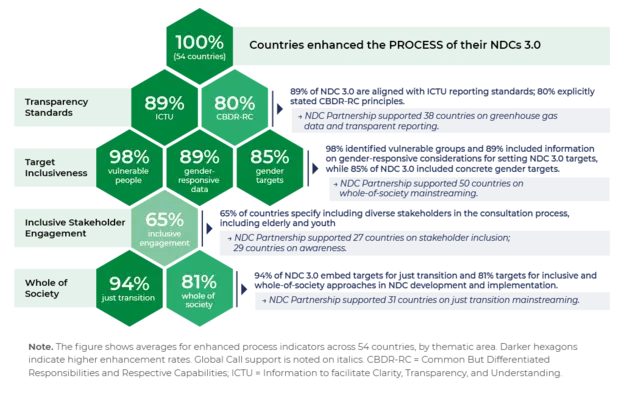
The strongest improvements observed overall are in the processes countries used to develop NDCs.
NDC development has become increasingly attentive to transparency, equity and participation, giving the people most affected by climate change a greater voice in shaping NDC targets and measures.
Countries strengthened their standards for transparency, increased stakeholder engagement, and placed greater emphasis on the needs of vulnerable groups, at-risk communities, youth and Indigenous Peoples, while embedding principles like gender-responsiveness and just transition into NDC planning.
The findings also suggest that many countries are increasingly approaching NDC development as a whole-of-government process, helping align climate priorities with broader development objectives and strengthening ownership across government.
Somalia, for example, engaged five federal ministries, over 700 stakeholder groups, people with disabilities, diaspora networks, the Somali NGO Consortium, and private sector associations, with all groups invited to a subsequent validation workshop. The NDC 3.0 dedicates a full chapter to just transition, with targeted investments in green job creation and vocational training focused on reskilling young people and women for emerging sectors.
These enhancements reflect a broader shift in how countries approach climate planning, treating NDCs not as standalone climate commitments but as nationally owned strategies that require coordination and buy-in across government and society.
However, while countries strengthened inclusiveness considerably, there is still significant progress to be made in this area, particularly in ensuring that commitments on inclusion are backed by accountability mechanisms.
Quality: Strengthening the Foundations for Action
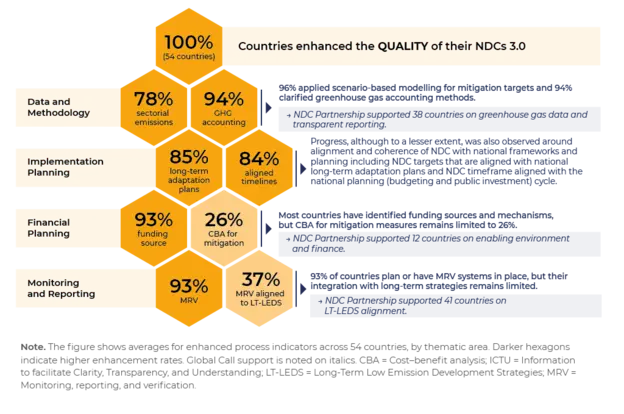
Countries strengthened NDC quality, with the most progress shown in implementation planning.
Earlier enhancement cycles focused on establishing the foundations for climate action, including greenhouse gas inventories, data-backed mitigation targets and climate governance frameworks. In the 2025 cycle, countries increasingly created the conditions needed to deliver climate objectives, putting forward stronger technical analyses, establishing clearer institutional arrangements and more detailed implementation planning.
Nearly all assessed countries strengthened the technical basis of their NDCs through scenario-based modeling for mitigation and improvements in greenhouse gas accounting. Many also enhanced governance arrangements, clarified institutional roles and established monitoring, reporting and verification (MRV) systems.
Rwanda, for example, restructured institutional responsibilities across five agencies based on a formal review of NDC implementation progress, linking climate commitments to clearly defined mandates, timelines and sector-level cost estimates.
These changes provide a stronger foundation for informed decision-making, investment planning and coordinated action across government institutions and sectors. Increasingly, countries are using NDCs not only to define where they want to go but also to articulate clearer pathways for getting there. They increasingly developed implementation and investment plans designed to support effective delivery.
Yet support for implementation and investment planning continues to lag behind country needs. Many countries aimed to develop their NDC and associated implementation plan at the same time, recognizing the important links between the two. However, while partners provided substantial support for the development of new NDCs, support for implementation and investment planning fell far short of demand, creating a disconnect between countries' efforts to strengthen their NDCs and their ability to implement those priorities.
This points to a deeper investment bottleneck. While most NDCs identified potential domestic and international funding mechanisms, robust economic modeling remains rare. Additionally, a small percentage included a formal cost–benefit analysis for their mitigation measures or macroeconomic impact assessments.
Ambition: Strengthening and Expanding Climate Targets
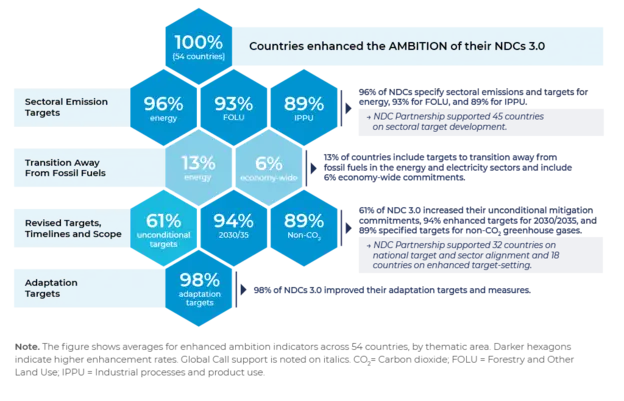
Countries have also made progress on ambition.
Adaptation is a high priority for developing country members of the NDC Partnership. Countries are expanding the scope and number of adaptation targets, providing greater geographical detail and paying increasing attention to loss and damage. Most also reference a National Adaptation Plan (NAP) or similar framework, helping anchor adaptation priorities within other national frameworks.
Armenia, for example, expanded adaptation commitments across eight sectors while developing regional plans linking province-specific climate risks and socioeconomic conditions to local planning and capacity building efforts. This combination of sectoral depth, quantified targets, subnational planning and documented vulnerability assessments reflects the increasingly sophisticated approach many countries are taking to adaptation.
The sectors most consistently covered in adaptation commitments are water resources, food security and agriculture, coastal zone management, health, and disaster risk reduction, demonstrating how countries are increasingly linking climate action with broader development priorities.
Countries are strengthening mitigation ambition in multiple ways, including by increasing economy-wide targets and specifying sector-specific targets, particularly in energy, land use and waste. Most countries also broadened the scope of greenhouse gases beyond carbon dioxide and embedded carbon sink targets.
Still, headline targets and absolute economy-wide emissions caps did not increase significantly. Relatively few countries set explicit targets to transition away from fossil fuels in the energy sector, and fewer extended these targets economy-wide. Additionally, long-term carbon neutrality or net zero targets remain unevenly addressed, with complex, overlapping terminology.
What the Findings Suggest
Countries are making meaningful progress across several dimensions of NDC development, with the most significant gains in the processes used to develop them. Across the 54 developing country NDCs analyzed, every submission improved in at least one of the three areas assessed — process, quality or ambition — and many improved across all three.
Increasingly, NDCs reflect stronger systems for climate action, including better data, more capable institutions, more inclusive planning processes, clearer implementation pathways and closer alignment with national development priorities.
Important gaps remain, however. While countries significantly improved transparency and stakeholder engagement, strengthening accountability will be essential. Although implementation planning advanced considerably, investment readiness continues to lag behind other areas of progress. And while adaptation ambition expanded substantially, relatively few countries strengthened fossil fuel transition commitments or articulated clear long-term decarbonization pathways.
Overall, the findings suggest that countries are moving beyond first-generation climate commitments toward more sophisticated, nationally owned planning that is better positioned to support implementation. The priority now is to help countries close the remaining gaps and turn stronger planning into effective implementation.
Priorities for the Next NDC Cycle
While countries have made significant progress, the findings point to several areas where targeted support can help strengthen future NDCs.
Raising ambition through implementation: In order to close the emission gap, opportunities to raise ambition should be pursued through effective implementation instead of waiting for the next NDC submission.
From targets to investment-ready plans: Support should enable countries to develop sector-specific investment plans with identified financing mechanisms, institutional responsibilities and delivery timelines that translate NDC targets into action on the ground. Access to finance to action these plans is critical.
Closing the economic and technology analysis gap: Targeted support for cost–benefit analyses, macroeconomic impact assessments and technology needs assessments can advance the areas where countries fell short this round, particularly in sectors where decarbonization depends heavily on technology deployment.
Making adaptation investment ready: The credibility of adaptation commitments will increasingly depend on the ability to quantify impacts and financing needs and to link adaptation priorities to concrete investment pipelines and financing sources.
Moving from commitment to accountability on social inclusion: Just transition and gender equity have moved from process considerations to substantive NDC commitments. The next step is ensuring these are backed by dedicated financing, measurable indicators and accountability mechanisms linked to the communities most affected.
-
The 54 countries were selected to form a representative sample of developing countries that had submitted their NDCs by February 2025 and requested support through the NDC Partnership’s Global Call for NDCs 3.0 and LT-LEDS.